Launching an Amazon private label product requires more than finding a supplier and creating a listing. Sellers must evaluate demand, source reliably, develop branding, control quality, plan inventory, optimize listings, and manage marketing.
A complete Amazon private label service coordinates these activities under one workflow, helping sellers reduce operational complexity while maintaining visibility into costs, quality, and key business decisions. This guide explains what these services include, how the process works, what they cost, and how to choose a provider.
Meta title suggestion: Amazon Private Label Service Guide | HighRise Wholesale
Meta description suggestion: Learn how an Amazon private label service supports product research, sourcing, branding, FBA preparation, listing optimization, and product launch.
What Is an Amazon Private Label Service?
An Amazon private label service helps sellers develop and launch products under their own brand. Services may include product research, supplier sourcing, sample evaluation, custom packaging, listing creation, FBA preparation, shipping coordination, and advertising setup.
Providers vary in scope. Some handle only sourcing or research, while a complete service coordinates the process from product selection through launch and post-launch optimization.
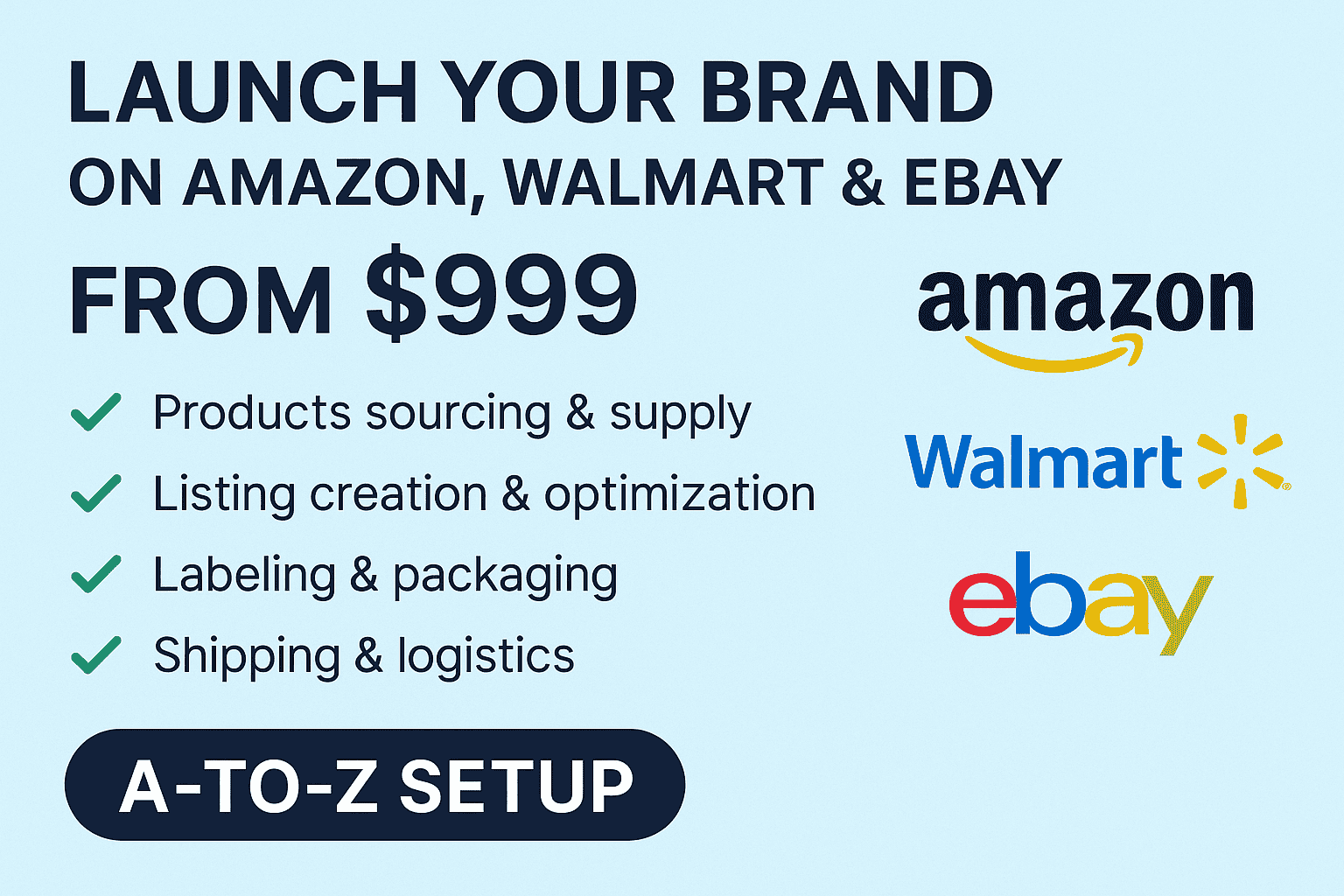
HighRise Wholesale provides end-to-end support for product sourcing, branding, packaging, quality checks, listing preparation, and fulfillment logistics.
Why Do Sellers Use an Amazon Private Label Service?
Private label requires expertise in market research, supplier negotiation, production, branding, Amazon operations, and marketing. Coordinating these tasks independently can be time-consuming and increase the risk of costly mistakes.
A professional service can help with:
- Product sourcing: Identifying manufacturers, comparing quotations, and negotiating order terms.
- Product research: Assessing demand, competition, pricing, costs, and profitability.
- Branding: Coordinating logos, packaging, labels, images, and brand guidelines.
- Quality control: Reviewing samples and arranging inspections before shipment.
- Launch preparation: Connecting sourcing, listing creation, shipping, inventory, and advertising.
A service provider does not eliminate business risk. Demand, competition, product quality, advertising costs, and profitability still depend on market conditions and seller decisions.
What Is Included in a Complete Amazon Private Label Service?
Before choosing a provider, confirm the exact deliverables, timelines, ownership terms, and additional charges.
1. Product Research
Product research should evaluate:
- Search demand and sales trends
- Competition and review strength
- Average selling prices
- Differentiation opportunities
- Sourcing, shipping, and Amazon fees
- Advertising requirements
- Seasonality and inventory risk
Tools such as Helium 10 and Jungle Scout can provide useful estimates, but they do not guarantee sales. The goal is to identify a realistic path to profitability, not simply a product with high sales volume.
For example, a product selling for $25 may appear attractive until sourcing, freight, Amazon fees, advertising, returns, and other expenses are deducted. A provider should assess estimated profit per unit alongside demand and competition.
2. Supplier Sourcing and Manufacturer Selection
Sellers may source from China, India, Vietnam, or other manufacturing markets depending on the product, order quantity, compliance requirements, and production capabilities.
Supplier evaluation typically includes:
- Identifying manufacturers
- Comparing specifications and quotations
- Confirming minimum order quantities
- Reviewing customization capabilities
- Evaluating capacity and lead times
- Requesting samples
- Discussing payment terms
- Verifying credentials where possible
Unit price should not be the only criterion. Communication, consistency, quality standards, reliability, and documentation are equally important. Confirm whether the supplier is a manufacturer, trading company, or intermediary.
HighRise Wholesale supports product sourcing and supplier coordination for private label projects.
3. Samples and Quality Inspection
A sample allows sellers to evaluate materials, dimensions, appearance, functionality, packaging, and overall quality before placing a bulk order.
For larger orders, pre-shipment inspections can identify defects, incorrect quantities, packaging problems, or differences from the approved sample. A useful quality process should define product specifications, acceptable defect levels, inspection procedures, and corrective actions.
Confirm whether sample costs, inspection fees, and testing charges are included. Inspection reduces risk but cannot guarantee defect-free inventory or strong customer demand.
4. Branding and Custom Packaging
Branding may include:
- Brand name and logo development
- Product labels
- Custom packaging
- Product inserts where permitted
- Brand colors and visual guidelines
- Packaging artwork and print coordination
Packaging should protect the product, meet applicable labeling requirements, and reflect customer expectations. Check all branding and claims against Amazon policies and category requirements.
Clarify ownership of logos, packaging artwork, photography, listing content, and other creative assets. Sellers should retain access if they later change suppliers or service providers.
5. Amazon Brand Registry Assistance
Amazon Brand Registry offers eligible brand owners tools for managing and protecting their presence on Amazon. A provider may help prepare brand information, coordinate trademark-related steps, and navigate the application process.
Trademark registration and Brand Registry are separate. A trademark application does not guarantee enrollment, and requirements vary by marketplace. Confirm eligibility, applicable government or professional fees, and the provider’s exact responsibilities.
6. Listing Creation and SEO
A listing must help shoppers understand the product while providing Amazon with accurate, relevant information. Services may include:
- Keyword research
- Titles and bullet points
- Product descriptions
- Backend search terms
- Image planning
- Infographics and lifestyle images
- A+ Content for eligible brands
- Category and attribute setup
Keywords should be used naturally in relevant fields, but placement alone is not enough. Listings must accurately describe the product, communicate benefits, use compliant images, and avoid unsupported claims.
Rankings and conversion rates cannot be guaranteed. Pricing, reviews, sales history, competition, inventory, and advertising also affect performance.
7. Product Photography and A+ Content
Because shoppers cannot inspect products physically, accurate images and clear information are essential. Creative services may include:
- Main product images
- Feature graphics
- Dimensions and usage demonstrations
- Lifestyle images
- Comparison graphics
- A+ Content layouts
Images must represent the actual product and comply with Amazon requirements. A+ Content can explain product differences and reinforce brand identity, but it does not guarantee higher sales.
Confirm whether photography, editing, infographic design, and A+ Content are included or billed separately.
8. FBA Preparation and Shipping
Fulfillment by Amazon stores inventory, fulfills orders, and handles many customer service functions under Amazon’s policies. Products must meet applicable preparation, labeling, packaging, and shipment requirements.
FBA preparation may include:
- Product labeling and FNSKU coordination
- Bundling and polybagging
- Carton labeling
- Packaging checks
- Shipment planning
- Freight coordination
- Customs documentation
- Delivery coordination
Requirements vary by product, category, packaging, and marketplace. International shipments may also involve freight costs, customs duties, import taxes, documentation, and importer responsibilities.
Request a landed-cost estimate before ordering. Landed cost includes the product, freight, customs, preparation, and other expenses required to deliver inventory to its destination.
HighRise Wholesale supports FBA preparation and shipping coordination, including direct shipment to Amazon fulfillment centers where feasible and permitted.
9. Launch and PPC Setup
Once inventory and the listing are ready, sellers can begin generating traffic through Amazon advertising. PPC setup may include:
- Keyword and targeting research
- Automatic and manual campaign planning
- Bid and budget recommendations
- Negative keyword planning
- Search term analysis
- Optimization guidance
Evaluate campaigns using sales, conversion rate, cost per click, ACoS, TACoS, and total profitability. ACoS measures advertising spend as a percentage of attributed sales; TACoS compares advertising spend with total sales.
For example, $100 in spend generating $300 in attributed sales produces an ACoS of approximately 33.3%. Whether that is profitable depends on product costs, Amazon fees, shipping, returns, and other expenses.
New products often require testing and optimization. No provider can legitimately guarantee sales, advertising returns, or organic rankings.
10. Post-Launch Support
After launch, sellers should monitor:
- Sales and advertising performance
- Inventory levels
- Customer feedback
- Listing quality
- Competitor activity
- Pricing and profitability
Ongoing support may include listing improvements, search-term analysis, replenishment planning, compliance coordination, and related-product expansion.
Replenishment plans should account for manufacturing lead times, shipping duration, demand variability, available cash, and Amazon inventory policies. Confirm whether post-launch support is included or charged separately.
How Much Does an Amazon Private Label Service Cost?
Pricing depends on the scope of work, product category, customization, order quantity, and target marketplace. Providers may charge separately for research, sourcing, branding, listing creation, and advertising, or offer bundled packages.
HighRise Wholesale private label packages start at $999, subject to project scope and quotation.
The service fee may not include inventory, samples, shipping, customs, Amazon fees, trademark expenses, or advertising. Request an itemized quotation covering:
- Services and deliverables
- Product and inventory costs
- Minimum order quantity
- Sample and inspection fees
- Branding and packaging
- Freight and customs estimates
- Amazon fees
- Advertising requirements
- Payment milestones
- Production and delivery timelines
Compare value rather than price alone. A low quote may exclude essential work, while a higher price does not automatically indicate better service.
How Much Money Do You Need to Start?
There is no universal starting budget. Capital requirements depend on unit cost, minimum order quantity, shipping, packaging, compliance, selling price, and marketing.
Plan for:
- Product development: Samples, design, testing, and modifications.
- Inventory: The initial production order.
- Logistics: Freight, customs, taxes, preparation, and delivery.
- Amazon costs: Selling plan, referral, fulfillment, storage, and related fees.
- Marketing: Advertising, photography, promotions, and launch testing.
- Working capital: Replenishment, returns, unexpected expenses, and operations.
Avoid committing your entire budget to the first order. Maintain a reserve for operating costs and replenishment, and approve purchases only after reviewing a realistic financial model.
How Long Does a Launch Take?
Timelines depend on product complexity, supplier readiness, sample approvals, customization, production, shipping, and Amazon processes.
The typical sequence is:
- Product research and opportunity assessment.
- Supplier comparison and quotation.
- Sample ordering and approval.
- Branding and packaging development.
- Production and quality checks.
- Shipping and FBA preparation.
- Listing preparation.
- Advertising activation and optimization.
Some projects take several weeks; others take longer because of testing, regulatory documentation, design changes, or international shipping. Request a milestone-based timeline with approval responsibilities and reasonable buffers.
How to Choose the Right Amazon Private Label Agency
Assess the provider’s capabilities, transparency, and communication rather than comparing package prices alone.
Consider:
- Service coverage: Confirm which stages are included.
- Cost transparency: Request a written list of included and excluded costs.
- Supplier verification: Ask how suppliers and samples are evaluated.
- Quality control: Review inspection procedures and corrective actions.
- Amazon compliance: Confirm that listings, packaging, claims, and fulfillment follow applicable rules.
- Communication: Establish project ownership, update frequency, and escalation procedures.
- Ownership: Clarify access to brand assets, design files, listings, and advertising accounts.
- Expectations: Avoid guaranteed sales, rankings, or risk-free profit claims.
- Post-launch support: Confirm assistance with advertising, inventory, and future products.
A trustworthy provider explains both opportunities and risks and helps sellers make informed decisions.
Common Amazon Private Label Mistakes
Choosing Based Only on Sales Volume
High demand does not guarantee profitability. Evaluate margins, competition, advertising, returns, and sourcing costs.
Ordering Before Approving a Sample
Skipping samples can lead to quality problems, incorrect specifications, and expensive modifications.
Ignoring Landed Cost
Unit price is only one expense. Freight, customs, preparation, Amazon fees, and advertising can materially reduce margins.
Underestimating Competition
Established brands may have stronger reviews, pricing power, customer loyalty, and advertising budgets.
Treating SEO as a One-Time Task
Listings should be reviewed as search behavior, competition, and performance data change. SEO cannot compensate for a weak product or poor customer experience.
Ordering Too Much Inventory
Large orders may reduce unit costs but tie up capital and increase storage risk. Balance supplier economics with realistic demand and available cash.
Failing to Plan for Compliance
Some products require testing, documentation, labeling, or approvals. Check requirements before production.
Expecting Immediate Profitability
New products may need time for testing, advertising refinement, and demand development. Plan for multiple sales scenarios.
Is a Complete Amazon Private Label Service Worth It?
A complete service can help entrepreneurs coordinate sourcing, branding, production, fulfillment, and launch, especially those new to international sourcing or Amazon FBA.
The value depends on the provider’s capabilities, deliverables, communication, and execution. Experienced sellers may outsource only selected tasks, while beginners may prefer broader support.
Regardless of the arrangement, sellers should retain control over product selection, investment limits, pricing, inventory commitments, and advertising budgets. Proceed only when the product economics justify the investment.
Why Consider HighRise Wholesale?
HighRise Wholesale helps entrepreneurs and established sellers coordinate private label development and Amazon FBA launch preparation.
Services may include product research, supplier sourcing, manufacturer coordination, branding, packaging design, quality checks, listing preparation, FBA prep, shipping coordination, and PPC setup. The company also supports wholesale sourcing and other e-commerce channels.
Private label projects start at $999, depending on requirements and scope. Inventory, freight, Amazon fees, and advertising should be evaluated separately unless included in a written quotation.
To begin, sellers can provide a product idea, reference listing, product images, target marketplace, estimated quantity, and budget. These details help determine feasibility and required services.
Frequently Asked Questions
What is included in a complete Amazon private label service?
Services may include product research, sourcing, samples, branding, packaging, quality inspection, listing creation, SEO, FBA preparation, shipping, and advertising setup. Request a written scope because deliverables vary.
How much does an Amazon private label service cost?
Pricing varies by provider and project. HighRise Wholesale packages start at $999. Inventory, shipping, customs, Amazon fees, and advertising may require additional investment.
Can a beginner use an Amazon private label agency?
Yes. An agency can coordinate sourcing, branding, listing preparation, and fulfillment. Beginners should still understand product economics, marketplace requirements, and investment risks.
Does a private label service guarantee sales?
No. Sales, profits, and rankings depend on demand, competition, pricing, product quality, advertising, customer satisfaction, and other factors.
Do I need a trademark?
Requirements depend on the brand protection features and programs you want to use. Brand Registry has marketplace-specific eligibility rules, and a trademark application does not guarantee enrollment.
Can an agency ship products directly to FBA warehouses?
A provider can coordinate direct shipping when the product, shipment, documentation, and preparation meet applicable requirements. Confirm who handles freight, customs, labeling, and delivery.
How do I select a profitable product?
Evaluate demand, competition, selling price, landed cost, Amazon fees, advertising, differentiation, and inventory risk. Use research tools as inputs, not guarantees.
How long does a launch take?
The timeline depends on sampling, customization, manufacturing, inspection, shipping, and listing preparation. Some projects take several weeks; others take longer. A milestone-based plan is more reliable than an unconditional promise.
Can I sell outside Amazon?
Yes. A private label brand may expand to marketplaces such as Walmart or independent e-commerce stores, each with its own requirements, costs, and operational needs.
Final Thoughts
A successful Amazon private label business depends on informed product selection, reliable sourcing, quality control, effective branding, compliant listings, efficient fulfillment, and ongoing performance management.
A complete service can coordinate these activities, but it does not replace financial planning or realistic expectations. Sellers should understand total launch costs, maintain working capital, and evaluate performance using actual data.
Whether launching a first product or expanding an existing brand, focus on sound economics, accountable partners, and a repeatable operating process.
For support with product research, sourcing, branding, listing preparation, or FBA launch coordination, contact HighRise Wholesale to discuss your project and request a quotation.
Explore Amazon private label services with HighRise Wholesale: